After many years of work, it was very pleasing to see results from our multi-centre RCT just published in the Lancet Infectious Disease showing improvements in oral care associated with reduction in non-ventilator associated pneumonia (NV-HAP).
Improvements in oral care were associated with a 60% reduction in the risk of acquiring NV-HAP.
Hospital‑acquired pneumonia has long been seen as an unavoidable complication of hospitalisation. Our research challenges that assumption. Oral care is not glamorous, expensive or technologically advanced — but this study shows its benefit. It strengthens the case for updating the importance of oral care in national infection‑prevention guidelines and nursing practice.
Sometimes, the simplest interventions are the most powerful!
The HAPPEN study – A recap
The RCT is part of the wider Hospital Acquired Pneumonia PrEveNtion (HAPPEN) study. The HAPPEN study is a three-phase study.
- Phase 1
- Working with consumers, clinicians, professional association and government to identify barriers to oral care and inform the intervention in Phase 2.
- Phase 2
- A multi-centre RCT evaluating the effectiveness of improving oral care on NV-HAP clinician and patient interviews
- Cost-effectiveness evaluation
- Phase 3
- Refinement of resources used in the study, working with consumers and patients
- Making resources open-source, freely available for use
For more information about the study, please visit our website.
What is next?
The project is not yet finished, much more to come, including completion of parts of Phase 2 and progressing Phase 3 as described above.
The project was funded by a MRFF Clinician Researchers: Nurses, Midwives and Allied Health grant opportunity. The wider HAPPEN team involved people affiliated with 16 different institutions across a range of disciplines.
As massive thanks for the wonderful team involved and to our partners, which include our consumers, ACIPC, NSW CEC, ACN, Sigma Nursing and other more.
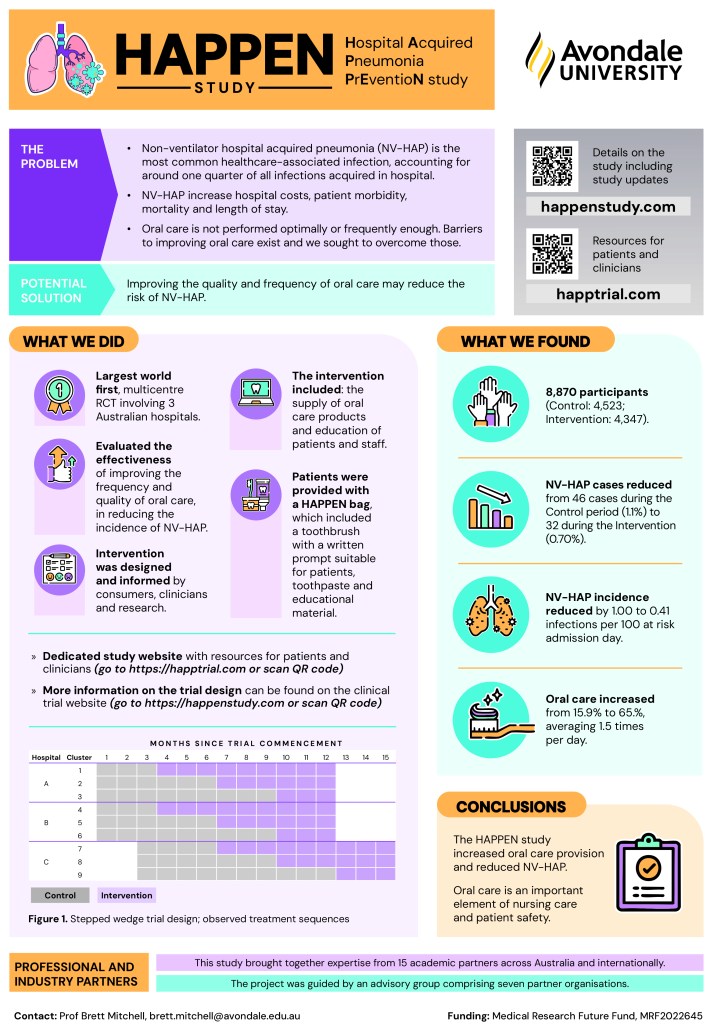
 The HAPPEN study
Leave a comment